Saturday, July 24, 2010

Circling the herbs, and other spices

Herbs planted and mulched

Curry Leaf , Murraya koenigii, is a member of the Rutaceae family with about 1800 species. Citrus and Boronia belong to this family, which is notable for aromatic glands on the leaves. The leaves are used almost daily in Malaysian cooking, and commonly in other asian cuisines. A handful of leaves stir-fried in oil, butter or ghee with ginger and garlic transforms any dish.  This plant is a small tree to 5 metres and has droopy ferny leaves.
Curry Leaf in flower

Boronia fraseri flower, another member of the Rutaceae family

This is Murraya paniculata,  used as a hedge and common in gardens here in the Hunter

Curry Plant (Helichrysum italicum) belongs to the Asteraceae family, which is also called the Compositeae. The family of Asteraceae/Compositeae are the daisy-type plants with a dazzling range of over 22000 species including globe artichokes, sunflowers and lettuce. Curry Plant only grows to about 50cms.


Curry plant

Chris planted a nice range of herbs with the help of Annie's grand-daughter.  


Thursday, July 22, 2010

Peak Soil

Here's a straight cut and paste from
http://www.thistlebrook.com.au/peak-soil

1. Keep the soil covered. Soil that has dried out during a drought has a diminished capacity to support microbial life and it’s more prone to being blown or washed away. Spread a layer of mulch, preferably something that will gradually break down to feed the micro-organisms in the soil. The use of cover crops in the veggie patch will perform a similar role.
2. Soil can be replenished. It takes time and effort to do so, but through the continual addition of organic matter to depleted soil, fertility can be significantly increased and microbial life enhanced. An added benefit of soils rich in organic matter is the capacity to store moisture. The easiest ways to improve soil at home are by making compost and growing green manures.
3. Avoid cultivating the soil. No till gardening isn’t practical (try growing carrots in non-sandy soil that hasn’t been dug), but we can all aim to make our practices minimum till. Don’t dig for the sake of exercise, and once soil has been dug, try to implement point one (above) as soon as possible. It’s also a good idea to regularly spell beds in the food producing garden."

So what is "Peak Soil"? Historic collapses of civilisations  coincide with fall in soil fertility due to over-grazing, no time for soils to replenish fertility between crops, and too much ploughing and tilling. The estimate for Australia and its ancient already depleted soils is around 2060. So read the bit above again, be kind to your garden. Farmers in the Big Garden are beginning to learn and adopt better practices.  Your grandchildren's grandchildren will have a future when we change our bad habits.  
Here's another place to get some information
http://www.towardfreedom.com/environment/1496-peak-soil

Sunday, July 11, 2010

Other community gardens

This is the website for the proposed  Warners Bay Community Garden.
http://www.warnersbaycommunitygarden.org.  I have just had an email from a friend who is one of the hopeful gardeners about a Vegeblitz the group did in her yard.  

"Well, I reckon the first Warners Bay Community Garden's organised VEGEBLITZ (today) was such fun - and wasn't the weather just gorgeous!
I wasn't sure if anyone would come, but I made a pot of pumpkin soup and fresh loaf of bread anyway... at least I would eat it if no-one else came.  I wondered if I should tidy up the garden - but I thought its probably better to see the 'before' and then (after the 1hr of work) the 'after'.
 I shouldn't have worried though - right on time at 1pm, I opened the door to see the first VEGEBLITZ team member - Tony, standing there ready for action with his own spade and pitchfork. We got stuck straight into the clean-up of my vege garden and were joined shortly after by several other friends (team members: Dani, Heidi, Lani, Sonia and Steve) - pulling out the ageing pumpkin vines, putting in my bags of manure and digging it through.  The diggings were quite interesting - with several strange bones and old gardening gloves etc found.  I'm not sure they believed my stories about the bones...."
The establishment of WBCG  garden is yet to happen after nearly two years. A great deal of angst has been caused through finger-pointing  of groups competing for use of the land at Bunya Park and Lake Macquarie council. Ominously, the website has "The Politics" in the list of pages.
Pointing a finger means there are three pointing back. Those three fingers are a reminder   
1/. the person pointing must do some self-examination of actions and motives  
2/. there is more than one  viewpoint to consider, 
3/. backing off and negotiating gets results.  
The warm soft space between the fingers and palm holds a good result, with a triumphant "thumbs-up". This applies to CSCG as well, both within the group and in our relationship with the landowners. And it can be done with one hand tied behind your back!!

Maree, the writer, has a resident group of Water Dragons in her native plant garden which take banana pieces from her hand and will even sit on her lap.  She regularly sends updates on her Dragon Diary. This picture is of George.


Friday, July 9, 2010

Photos of features and new growth

 This small grevillea will grow to about 1 metre and bring in the birds in Winter
  
One lonely surviving banana in its protective nest


Raindrops on oranges and mud on my gummies

The parterre garden has been planted with a geometric pattern of flowers, herbs and vegetables in rings of colour - red, purple, orange - which will show up as the plants mature. 
"Parterre" simply means "on the ground". 
So Duh! aren't all gardens like that, on the ground? 
Originally they were show-off gardens of gravel and carefully clipped hedges which allowed you to demonstrate your wealth because you could command the services of many serfs/slaves/servants - parterres of this type were and are high maintenance. Ideally you would stand at a height and view the pattern created in the garden, usually from the raised platform in front of a glorious chateau. 
We will have to make do with the steps behind the Old Hall and we are a bit short on serfs.

Friday, June 25, 2010

Newcastle City Council Community Grants and Sponsorship

When we were still Villiers Street Community Garden we applied for and received a "Seed grant" to help us establish. The $1280 had to sit untouched while we worked through our future. If we couldn't find a place to garden when the time for acquittal came we would have had to refund the cash. Fortunately that didn't happen. Yesterday Louise Duff, Community Assistance Coordinator, came for a visit to see the new garden and receive our final report. This is a great program, one to be supported by applying.  Even a small amount of money has an enormous effect. As gardeners we have all the material equipment we need for the forseeable future to make the work of growing and maintaining much easier. The grants are available annually and a visit to the NCC website gets you the guidelines and forms necessary.  
The Community assistance   program includes -
Sports Partnership Program - Helps provide facilities to sporting groups to promote the development of sport.
Community Place Makers Small Grant Program - A quick turnaround program to kick start place making with amounts up to $1,000.
Council Subsidies - Council services, including venue and mobile stage hire, are available to community groups.

CSCG Inc has applied for a Placemakers Grant for a Sausage Sizzle to be held in conjunction with the St Andrew's church fete in October. As part of that grant we have applied for the funds for an Access Industries picnic bench set, the kind you see in all the public parks. The domestic picnic sets we have are below the standards set for public spaces.  You know the kind  - warn your neighbour you are going to stand up or the bench will tip them off.

Louise was able to see the facilities offered by the church hall so she now has personal knowledge of the space and the possible uses community groups could make of it. Very nice visit and I was so busy talking I forgot to take photos.

Monday, June 21, 2010

Knights in the Gardens of Mayfield

Now for the fascinating part of Saturday.
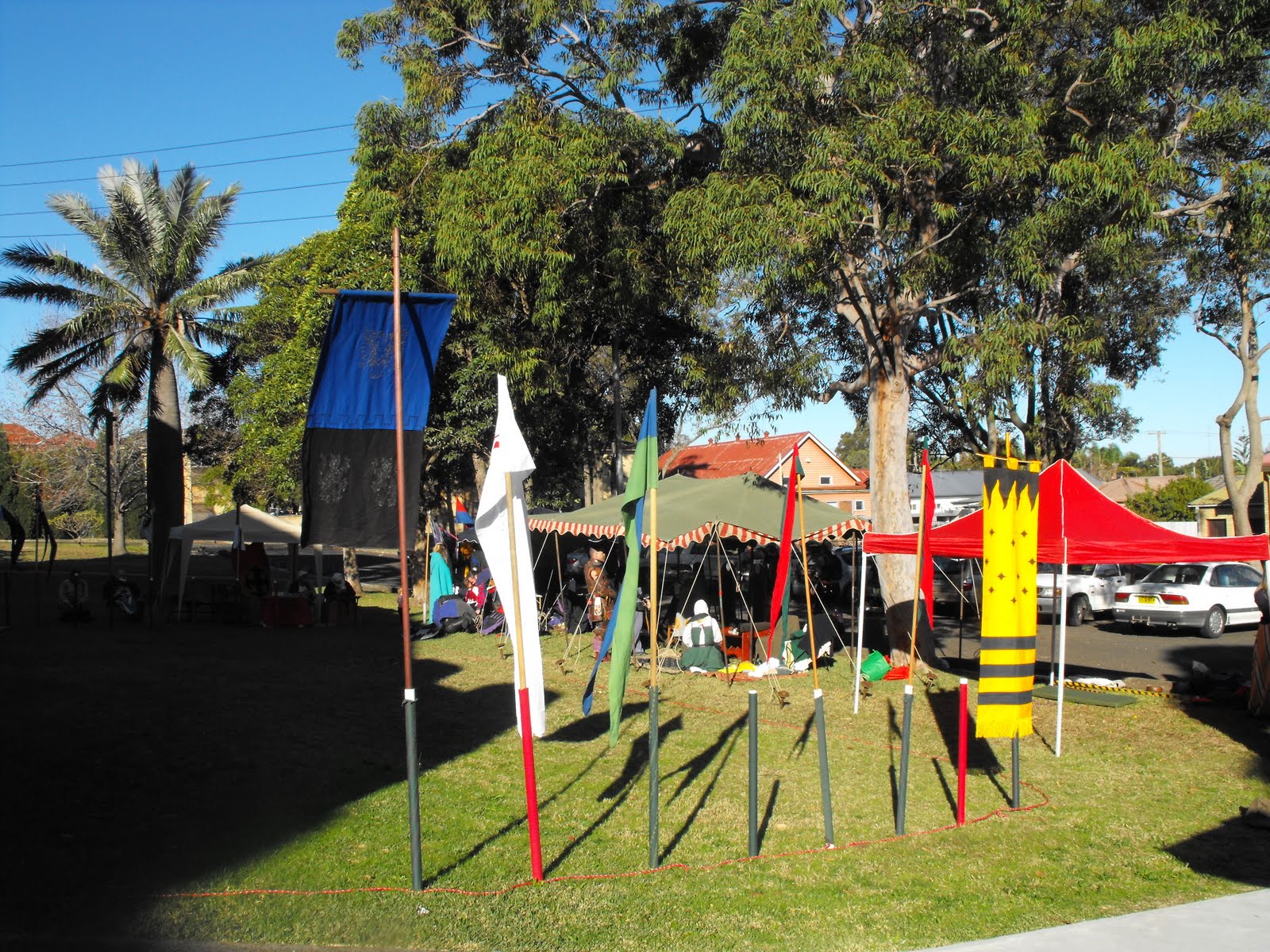
Pre-16th century life came to Mayfield with the arrival of the Heralds, Knights, Ladies and a serf or two of www.sca.org - Society for Creative Anachronism. A day of Foot Combat on the lawn, then a mediaeval  feast in the hall. The winners of the day's combat would become the King and Queen for the next six months.

Here is the Herald and a Knight. The Herald graciously performed his role and explained  much about the day and the group. Giving contemporary reality to the study and re-creation of dress, food, history, music, art, and much more,  of a past era. 
This Knight's French pattern armour was new and needed some re-adjustment on a lump of railway track. Most adopt western European costume, but some take on Mongol and Samurai dress. Chain-mail is still the expensive luxury it was in the 12C, so making your own is an option. One man took two months on train trips and in Uni  lectures to make a chain-mail shirt down to his wrists and knees.

Crop circles

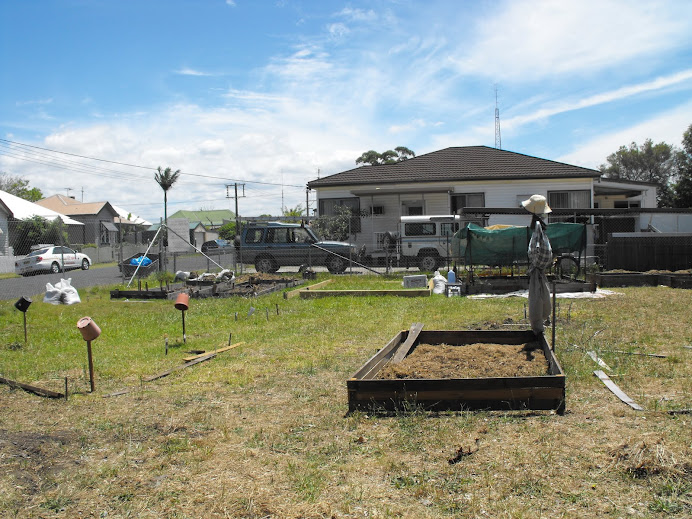
Saturday was  both a productive and fascinating day.  Carol, (church Secretary), came early and we raked up autumn leaves. At first we put them on the bare ground along  the fence-line. We wondered why the ground was so bare as the rains and still-warm soil has sprouted plenty of growth elsewhere. Later found out from Rev Andrew that the soil is basically nuked with poison each year as part of Council or Hunter Water maintenance of an easement.  Future doesn't look good in the short-term for the plants Allan had put in, and explained why the holes he had dug looked like desert craters - dry and dusty. That area will need some serious mulching and building up before any self-respecting soil biota has a go at living in it.
Annie came along later and installed the next crop circle. By afternoon Kerry (with Zebediah) , Carol, Lachlan and Chris had added their muscle and some cow manure, sheet-mulched with cardboard and chucked in the rest of the leaves. Potatoes come next. Zebediah found the smell and sight of cow manure irresistible and the perfect way to cover up the perfume of a recent bath.

Lachlan and Chris have started Tree Frog Permaculture under the N.E.I.S scheme. Over the next twelve months they will get support  to establish a new business of permaculture garden design and construction.  Email  christopher.wallis@gmail.com, phone 0418 484 330, 02 49100123.